How to Manage Employees with Long-Term Medical Illness: A Complete Guide for New Zealand Employers
Learn how to manage employees with long-term medical illness in New Zealand. Understand employer responsibilities, reasonable accommodations, medical incapacity, and legal compliance.
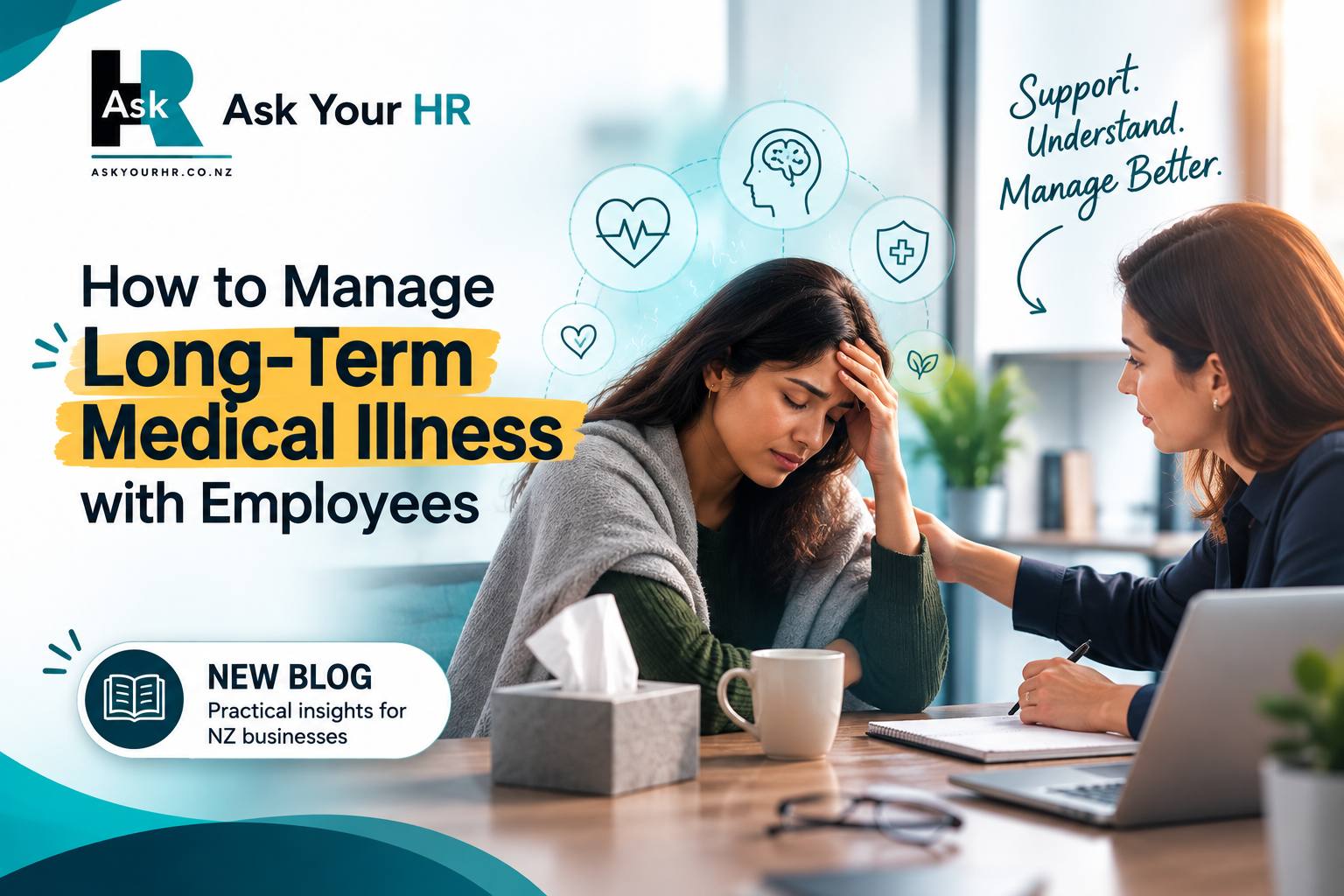
Managing an employee with a long-term medical illness is one of the most sensitive and challenging responsibilities for any employer.
While every business relies on employees being present and productive, employers also have a legal and ethical responsibility to treat employees fairly when illness affects their ability to work.
Finding the right balance between supporting your employee and protecting your business requires empathy, consistency, good communication, and compliance with New Zealand employment law.
This guide explains how employers can confidently manage long-term medical illness while maintaining a supportive workplace and reducing legal risk.
What is a Long-Term Medical Illness?
A long-term medical illness is a health condition that significantly affects an employee's ability to perform their normal duties for an extended period.
Examples include:
- Cancer
- Heart disease
- Stroke recovery
- Multiple sclerosis
- Chronic pain
- Diabetes complications
- Mental health conditions
- Long COVID
- Serious workplace injuries
- Autoimmune diseases
Some illnesses may require employees to be away from work for months, while others may allow them to continue working with suitable adjustments.
Why Managing Long-Term Illness Properly Matters
Poorly managed medical situations can lead to:
- Personal grievance claims
- Discrimination complaints
- Low employee morale
- Loss of trust
- Legal costs
- Operational disruption
On the other hand, employers who respond fairly often retain valuable employees, improve workplace culture, and strengthen their reputation as employers of choice.
Employer Responsibilities in New Zealand
When an employee experiences a long-term illness, employers have several important obligations.
These include:
- Acting in good faith
- Communicating openly
- Considering reasonable workplace adjustments
- Respecting employee privacy
- Following a fair process before making employment decisions
Employers should avoid making assumptions about an employee's ability to return to work without appropriate medical information.
Step 1: Maintain Open and Compassionate Communication
When an employee informs you of a serious medical condition, your first response sets the tone for the entire process.
Instead of focusing immediately on operational impacts, begin with empathy.
For example:
"Thank you for letting us know. Your health is the priority. Please focus on your recovery, and we'll work together to understand what support may be needed."
Regular check-ins should remain supportive rather than intrusive.
Avoid repeatedly asking when they will return. Instead ask:
- How are you feeling?
- Is there anything we can do to support you?
- Have your doctors provided any updates?
- Would you like to discuss a gradual return to work?
Step 2: Understand the Medical Situation
Employers should make informed decisions based on medical evidence — not assumptions.
Depending on the circumstances, it may be appropriate to request:
- Medical certificates
- Fitness-for-work reports
- Specialist reports
- Information about workplace restrictions
- Estimated recovery timelines
Remember that employers generally need the employee's consent before obtaining medical information directly from healthcare providers.
Step 3: Consider Reasonable Workplace Adjustments
Before considering more significant employment decisions, explore whether the employee can continue working with suitable modifications.
Examples include:
Flexible hours
Allowing later start times or shorter working days.
Reduced workload
Temporarily removing physically demanding or high-pressure tasks.
Hybrid or remote working
Where practical, allowing employees to work from home.
Modified duties
Allocating alternative responsibilities that better match the employee's current capacity.
Workplace equipment
Providing ergonomic furniture, assistive technology, or other practical adjustments.
Often, small changes enable valuable employees to remain productive.
Step 4: Develop a Return-to-Work Plan
Returning after a serious illness can be overwhelming.
A structured Return-to-Work Plan should include:
- Expected return date
- Temporary work restrictions
- Hours of work
- Duties
- Workplace adjustments
- Regular review meetings
- Medical review dates
A gradual return often leads to better long-term outcomes than expecting employees to immediately resume full duties.
Step 5: Keep Accurate Documentation
Throughout the process, maintain records of:
- Medical certificates
- Meeting notes
- Emails
- Workplace adjustments
- Return-to-work plans
- Performance discussions
Accurate documentation protects both the employee and the employer.
When Does Long-Term Illness Become a Business Issue?
There may come a point where an employee is unable to perform the essential requirements of their role despite reasonable support.
This may occur when:
- There is no foreseeable return-to-work date.
- Medical advice indicates the employee is permanently unable to perform their role.
- Business operations are significantly affected.
- Reasonable workplace adjustments are no longer practical.
Even in these circumstances, employers should follow a fair consultation process before making any employment decisions.
Managing Medical Incapacity
Medical incapacity is one of the most misunderstood areas of employment law.
Medical incapacity does not automatically justify dismissal.
Before considering medical incapacity, employers should ensure they have:
- Obtained current medical information.
- Consulted with the employee.
- Considered alternative duties.
- Explored reasonable adjustments.
- Allowed sufficient recovery time where appropriate.
- Considered the operational impact on the business.
Each situation must be assessed individually.
Supporting Employee Wellbeing
Supporting employees through serious illness benefits both individuals and businesses.
Employers can assist by offering:
- Employee Assistance Programmes (EAP)
- Mental health support
- Flexible work arrangements
- Regular wellbeing check-ins
- Manager support
- Wellness initiatives
Employees who feel genuinely supported are often more engaged and loyal when they return.
Common Mistakes Employers Should Avoid
Many employment disputes arise because employers act too quickly.
Avoid:
- Assuming an employee will never return.
- Pressuring employees to resign.
- Discussing confidential medical information with colleagues.
- Ignoring medical advice.
- Failing to consult the employee.
- Making inconsistent decisions.
- Treating similar situations differently.
Best Practices for HR Managers
Successful organisations generally:
- Maintain regular communication.
- Respect employee privacy.
- Review medical information objectively.
- Offer reasonable workplace adjustments.
- Create Return-to-Work Plans.
- Train managers on handling sensitive health matters.
- Keep detailed records.
- Follow fair consultation processes.
Frequently Asked Questions
Can an employer dismiss someone because they are sick?
Not simply because they are sick. Any decision to end employment due to long-term illness or medical incapacity should only be made after a fair process, careful consideration of medical evidence, consultation with the employee, and exploration of reasonable alternatives. Employers should seek professional HR or legal advice before making such decisions.
Can employers ask for medical information?
Yes. Employers may request relevant medical information where it is necessary to understand an employee's ability to perform their role or to consider appropriate workplace adjustments. Requests should be reasonable and respect the employee's privacy.
Should employees be offered alternative duties?
Where practical, yes. If an employee cannot perform their usual role but can safely undertake alternative duties, employers should consider whether suitable temporary or permanent adjustments are available.
What if there is no expected return-to-work date?
If medical advice indicates there is no foreseeable return, employers should consult with the employee, consider all reasonable options, assess the impact on the business, and follow a fair process before making any employment decisions.
Final Thoughts
Managing employees with long-term medical illness is about balancing compassion with business needs. A fair, well-documented, and supportive approach not only helps employers meet their legal obligations but also builds trust, loyalty, and a positive workplace culture.
By communicating openly, considering reasonable workplace adjustments, relying on appropriate medical information, and following a structured process, employers can make informed decisions while treating employees with dignity and respect.
At Ask Your HR, we work with businesses across New Zealand to manage complex employee health matters, medical incapacity cases, return-to-work planning, employment relations, and HR compliance. Whether you need guidance on supporting an employee through a long-term illness or navigating a challenging employment situation, our experienced HR consultants are here to help.
This article provides general information and does not constitute legal or HR advice. The right approach may vary from case to case. If you need specific advice for your situation, please contact us.
Need help with something specific?
Book a free HR audit and we'll show you where the gaps are.
Contact Us